
Blog
How Technology is Revolutionizing Property Development and Construction

Introduction
The real estate and construction industry has traditionally been perceived as a labor-intensive sector driven by manual processes and conventional building methods. However, the digital revolution is rapidly transforming how properties are planned, designed, constructed, managed, and sold.
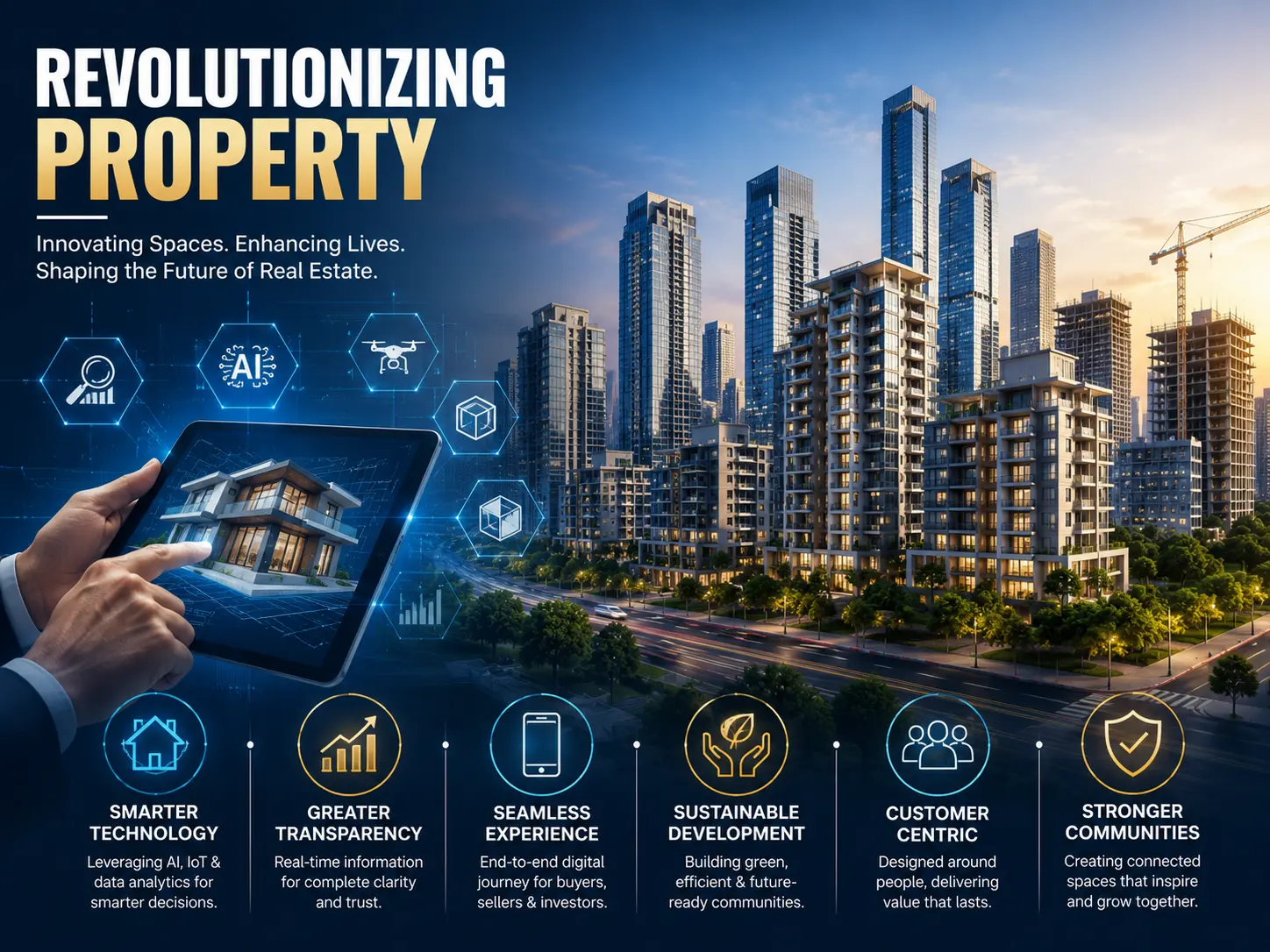
From Artificial Intelligence (AI) and Building Information Modeling (BIM) to drones, IoT-enabled smart buildings, and construction automation, technology is reshaping every stage of the property development lifecycle. Developers are now able to build faster, reduce costs, improve quality, enhance sustainability, and deliver superior customer experiences.
As India's real estate sector moves toward a more technology-driven future, embracing innovation is no longer optional—it is becoming a competitive necessity.
The Rise of Construction Technology (ConTech)
Construction Technology, often referred to as "ConTech," encompasses digital tools, software, automation systems, and smart equipment that improve efficiency throughout the construction process.
Modern construction projects now leverage technology to:
Improve project planning
Reduce material wastage
Monitor site progress in real-time
Enhance worker safety
Improve construction quality
Accelerate project completion
The result is greater productivity, reduced operational costs, and improved project outcomes.
1. Building Information Modeling (BIM): Transforming Project Planning
One of the most significant innovations in construction is Building Information Modeling (BIM).
BIM creates a digital 3D representation of a building before construction begins. It integrates architectural, structural, mechanical, electrical, and plumbing systems into a single collaborative platform.
Benefits of BIM:
Accurate project visualization
Early detection of design conflicts
Reduced construction errors
Better cost estimation
Improved project coordination
Faster approvals and execution
Developers can now identify potential issues before construction starts, saving both time and money.
2. Artificial Intelligence (AI) and Predictive Analytics
Artificial Intelligence is becoming a game-changer for property developers and construction firms.
AI-powered systems can analyze large volumes of data to improve decision-making and project management.
Applications of AI:
Construction scheduling
Cost forecasting
Risk assessment
Market demand prediction
Resource optimization
Property valuation
Developers can use AI to forecast project delays, optimize procurement, and identify investment opportunities with greater accuracy.
3. Drones for Site Monitoring and Surveying
Drone technology has revolutionized site inspections, land surveys, and project monitoring.
Traditional land surveys that once required days or weeks can now be completed within hours using aerial mapping technology.
Advantages of Drones:
Faster site surveys
Real-time progress monitoring
Accurate topographical mapping
Improved safety inspections
Reduced surveying costs
Project managers can monitor construction progress remotely and identify issues before they become costly problems.
4. Smart Buildings and IoT Integration
The Internet of Things (IoT) is transforming modern buildings into intelligent environments.
Smart sensors, connected devices, and automation systems allow buildings to collect and analyze data continuously.
Smart Building Features:
Automated lighting systems
Intelligent HVAC controls
Energy monitoring
Smart security systems
Occupancy management
Predictive maintenance
These technologies enhance occupant comfort while significantly reducing energy consumption and operational costs.
5. Prefabrication and Modular Construction
Traditional construction methods often face challenges related to labor shortages, weather disruptions, and project delays.
Prefabrication and modular construction address these issues by manufacturing building components in controlled factory environments before transporting them to the construction site.
Benefits:
Faster project completion
Improved quality control
Reduced material waste
Lower labor dependency
Enhanced workplace safety
Many developers are adopting modular construction techniques to accelerate project delivery and improve consistency.
6. 3D Printing in Construction
3D printing is emerging as one of the most disruptive technologies in the construction industry.
Large-scale 3D printers can create building components and even entire structures using specialized concrete mixtures and advanced materials.
Potential Advantages:
Rapid construction
Reduced material waste
Lower construction costs
Complex architectural designs
Sustainable building practices
As technology advances, 3D printing could significantly reduce housing shortages and construction timelines.
7. Virtual Reality (VR) and Augmented Reality (AR)
Property buyers no longer need to rely solely on brochures and floor plans.
Virtual Reality and Augmented Reality enable immersive property experiences before construction is completed.
Applications:
Virtual property tours
Interactive walkthroughs
Design visualization
Customer customization
Sales and marketing presentations
Developers can showcase projects more effectively while helping buyers make informed decisions.
8. Project Management Software and Digital Collaboration
Construction projects involve multiple stakeholders including architects, engineers, contractors, suppliers, and developers.
Cloud-based project management platforms enable seamless communication and collaboration among all participants.
Benefits:
Real-time updates
Centralized documentation
Task tracking
Budget monitoring
Improved accountability
Enhanced productivity
Digital project management significantly reduces delays caused by communication gaps and manual paperwork.
9. Sustainable Construction Technologies
Sustainability has become a major priority in modern real estate development.
Technology is helping developers reduce environmental impact while improving long-term building performance.
Green Technologies Include:
Solar energy systems
Rainwater harvesting
Smart energy management
Green building materials
Water-efficient fixtures
Waste management systems
Sustainable buildings often achieve lower operating costs and higher market value while meeting evolving environmental standards.
10. Digital Procurement and Supply Chain Management
Construction projects depend heavily on efficient procurement and material management.
Digital procurement platforms enable developers to source materials more efficiently, compare prices, track deliveries, and manage inventory in real time.
Benefits:
Better price transparency
Reduced procurement delays
Improved inventory control
Enhanced supplier management
Lower material wastage
Technology-driven supply chains improve project efficiency and reduce cost overruns.
The Future of Property Development
The future of construction is increasingly driven by data, automation, and intelligent systems.
Emerging technologies expected to gain momentum include:
AI-driven project planning
Autonomous construction equipment
Robotics in construction
Digital twins
Smart city integration
Blockchain-based property transactions
Advanced sustainability solutions
Developers who adopt these technologies early will gain significant advantages in efficiency, quality, and profitability.
Challenges in Technology Adoption
Despite the benefits, the industry still faces challenges:
Common Barriers:
High initial investment costs
Skill and training requirements
Resistance to change
Integration complexities
Data security concerns
However, as technology becomes more accessible and affordable, adoption rates are expected to accelerate across the industry.
Conclusion
Technology is fundamentally transforming the property development and construction sector. From AI-powered planning and BIM-based design to drones, smart buildings, and modular construction, innovation is creating a more efficient, sustainable, and customer-centric industry.
For developers, contractors, investors, and building material suppliers, embracing digital transformation is essential for long-term success. The companies that leverage technology effectively will not only build faster and smarter but will also deliver greater value to customers and stakeholders.
As India's urban landscape continues to evolve, technology will remain at the heart of the next generation of real estate and construction development.
The future of construction is not just about building structures—it is about building smarter, faster, safer, and more sustainable environments for generations to come.